
Abstract
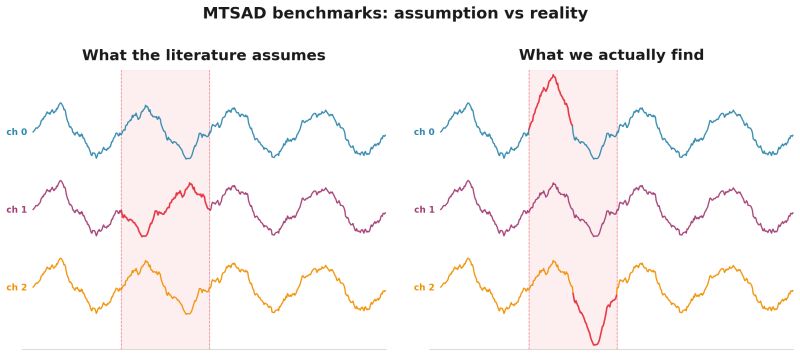
Many recent multivariate time series anomaly detection (MTSAD) models incorporate cross-channel modeling, under the implicit assumption that the structure of anomalies may be spread across multiple channels. We evaluate this assumption on eight widely used public benchmarks by introducing a per-segment diagnostic framework that flags, for each labeled anomaly, whether at least one channel deviates individually from its normal history, whether the cross-channel correlation structure changes, or both. The framework shows that no cross-channel rupture occurs without an accompanying univariate deviation across a range of reasonable thresholds. A complementary metric also reveals that on six of the eight benchmarks, at least half of the labeled anomaly segments deviate univariately on 89% to 100% of their timesteps, reaching 100% on three of these datasets. To verify that our framework captures cross-channel structure when present, we construct synthetic data of phase-shifted sinusoidal channels with shared noise. Each anomalous segment is altered through one of two channel-wise corruptions that preserve the per-channel marginal distribution while breaking cross-channel structure, and our framework correctly characterizes these segments as cross-channel-only. On these data, channel-dependent (CD) models successfully exploit the cross-channel signal whereas channel-independent (CI) ones fail. The CI/CD comparison of a recent SOTA detector on real benchmarks further confirms that CD modeling brings no measurable gain. We conclude that current MTSAD benchmarks are unsuitable for validating cross-channel modeling capabilities, and we call for the development of more structurally diverse evaluation sets. The code for this study is publicly available.
BibTeX
@inproceedings{Pinet2026AnomaliesIM,
  title={Anomalies in Multivariate Time Series Benchmarks Are Mostly Univariate},
  author={Marc Pinet and Julien Cumin and Samuel Berlemont and Dominique Vaufreydaz},
  booktitle={The 12th Mining and Learning from Time Series (MiLeTS), KDD 2026},
  year={2026},
  url={https://doi.org/10.48550/arXiv.2606.02670}
}